
A Safe Place to Heal: How Community Voices Secured Protection for Survivors of Gender-Based Violence in Kwale County
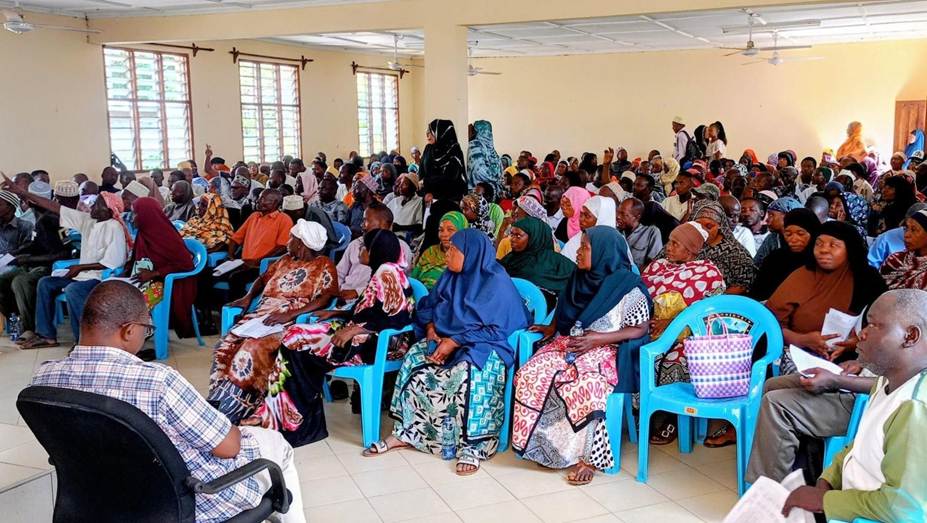
For many survivors of gender-based violence in Kwale County, escaping abuse did not guarantee safety. With no safe houses available, women and girls were often forced to return to abusive homes, seek temporary shelter with relatives, or stay in police stations ill-equipped to provide protection and psychosocial care. Despite these challenges, survivor protection remained largely absent from county planning and budget priorities, until communities came together to demand change.
Turning Awareness into Action
Through the Advancing Grassroots GBV Prevention and Accountability Project, implemented by The Hijabi Mentorship Program (THMP) under the Haki Ni Yetu Project, community members were equipped with something powerful: the knowledge that they could influence government decisions.
Over the course of four public participation trainings and four budget advocacy sessions, 180 community members from Matuga, Msambweni, Kinango, and Lungalunga learned how county planning and budgeting processes work and, more importantly, how ordinary citizens can shape them.
Participants gained practical skills on constitutional rights, public participation, county budgeting, and the implementation of the Kwale County Sexual and Gender-Based Violence Act. Armed with this knowledge, they attended public participation forums determined to ensure that survivor protection became a county priority.
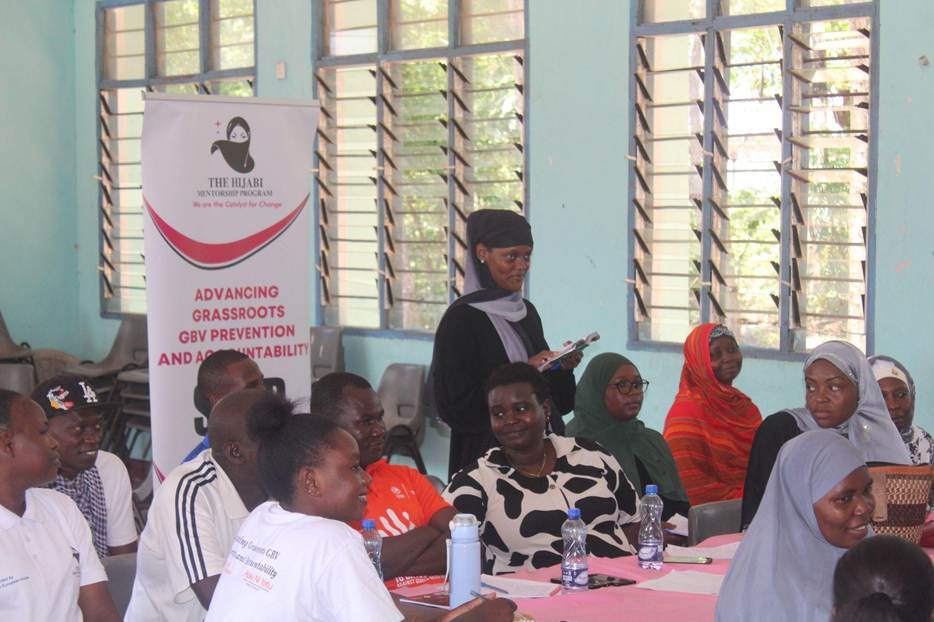
Community members participate in a public participation training, strengthening grassroots capacity to effectively engage in public participation forums and advocate for the implementation of the Kwale County SGBV Act (2023). Photo | THMP.
One community participant, Mwanakombo Ali Gonga from Tsimba Golini, reflected on the experience:
“As a young person, I had heard about public participation but had never attended before, Today, I have learned about the importance of public participation, and I hope to continue attending and taking part in more public participation forums.”
A Historic Win for Survivors: The Safe Houses
Community members consistently raised the need for safe houses during county public participation forums in Tsimba-Golini, Ukunda, Tiwi, and Waa-Ng’ombeni wards. They demonstrated that access to justice couldn’t exist without safe accommodation, psychosocial support, and secure environments where survivors can recover while pursuing legal action. Their persistence paid off.
For the first time, the Kwale County Government allocated funds in its 2026/2027 Annual Development Plan for the construction and operationalization of two safe houses and recovery centres in Kinango and Lungalunga Sub-Counties.
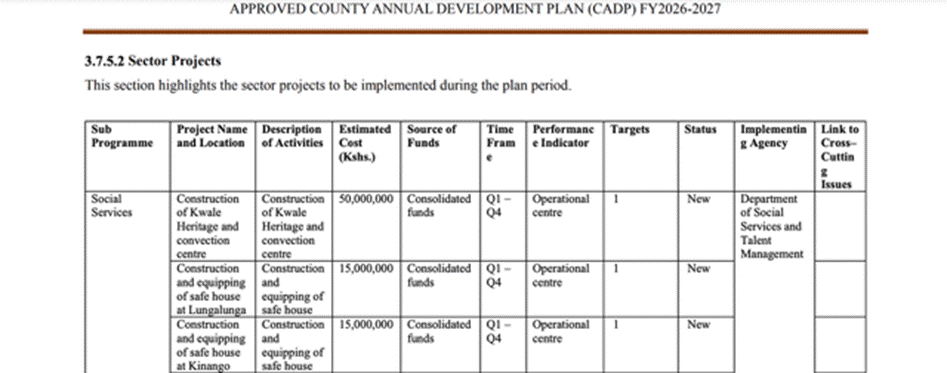
Screenshot of the approved construction of safe houses in Kwale County as captured in the Approved Annual Development Plan for FY 2026/2027. For more details, see page 162 of the plan.
The allocation of funds for two safe houses marks a significant milestone, but it is only the beginning. Kwale County still needs additional survivor-centred services, including more safe houses across all six sub-counties, stronger psychosocial support systems, improved referral mechanisms, and a county forensic laboratory to ensure survivors can access timely justice.
Nevertheless, the achievement proves what is possible when informed citizens, civil society, and government work together. For survivors of gender-based violence, these safe houses will offer more than shelter. They will provide dignity, protection, and hope.
Project Impact at a Glance
- 180 community members trained on public participation, governance, and budget advocacy.
- Community members successfully influenced county budgeting processes.
- Two safe houses and recovery centres included in the 2026/2027 County Annual Development Plan.
- Increased citizen participation and accountability in county governance.
- Strengthened implementation of the Kwale County Sexual and Gender-Based Violence Act (2023).
THMP receives funding through the 2nd open call of the Rights, Governance and Accountability Grants (Large Grants) of the Haki Ni Yetu project. The Haki Ni Yetu project is funded by the EU Delegation to Kenya. You can learn more about the project here: https://kios.fi/en/haki-ni-yetu/

This page is funded by the European Union. Its contents are the sole responsibility of the KIOS Foundation & The Haki Ni Yetu project and do not necessarily reflect the views of the European Union.